

Is it Safe for Women to Travel India?
 The
issue of women’s safety in India has been in the news frequently
lately. Many women have expressed concerns about traveling there, and
many more have opted not to go at all. I’ve never been to India — and
I’m also not a woman — but I feel this is an important subject to
discuss. Today, please welcome Candace Rardon, who spent many months traveling around India by herself, to discuss safety and solo travel in India.
My introduction to India came behind the wheel of an auto-rickshaw.
For two weeks in 2011, my friend Citlalli and I took part in the Rickshaw Run, driving one of India’s ubiquitous three-wheeled vehicles 2,000 miles across the country.
On
our fifth morning, we spent three hours wrestling our way through an
18-mile traffic jam in Bihar, a state known for its poverty and
violence. After the second hour, I needed a break from dodging trucks
and buses and cows, and so we pulled over.
Instantly a crowd of
about 20 men surrounded our rickshaw. Citlalli and I nervously said
hello, hoping to break the tension we felt as two foreign women in such a
situation, when a white-haired shopkeeper approached us. In his hand
were two tiny cups of sweet, steaming chai.
I tried to explain
that we were out of small change and couldn’t pay him for the tea, but
he insisted, saying, “I may be poor, but I still have a heart.”
Why go to India?

I am aware of the various threats facing Indian women and foreign visitors alike: staring, groping, stalking, and most seriously, rape. With such threats forever hanging over a female traveler’s head, it makes sense to wonder if India is worth the worry and the hassle. Why not skip it entirely in favor of less troublesome destinations?
One reason: No country will fascinate and frustrate you more.
While
travel in India will require heightened attention and common sense, let
me assure you it is worth it. Although I did encounter men who stared
at me inappropriately, there were countless others who in no way treated
me as a sexual object: farmers and pharmacists, shopkeepers and
teachers, men whose warmth, kindness, and compassion moved me in
unexpected ways.
The man who gave us chai in Bihar was only the
beginning. There was the time I had Delhi belly in Bhubaneswar and a
hotel worker brought me yogurt with sugar; the time I was waiting for a
friend’s flight to arrive at 1:00 am, and a guy I struck up a
conversation with invited us to his sister’s wedding the next week; and
the time I jumped off a train in Chennai and a man led me across the
street to buy gauze and disinfectant to patch up my skinned knee.
It
is impossible to stereotype a nation of one billion people, and bad
experiences there will naturally be impossible to avoid. The challenge
lies in refusing to accept such occurrences as the status quo, while
still choosing to focus on the positive. This might sound trite or
naïve, but it’s a choice that India demands of you.
Drawing on my
own time in India as well as advice from other women who have traveled
there extensively, here are 11 tips to help ward off unwanted situations
— but also keep you open to positive experiences:
1. Do your homework

As you would for any destination, spend time learning about India and its customs before arriving. Go in with your eyes wide open, having taken the necessary steps to be educated and prepared, and understand that what awaits you there may be vastly different from what you’re used to.
Beth Whitman, founder and CEO of Wanderlust and Lipstick and WanderTours,
has been leading both female-only and co-ed tours to India since 2009
— and not once has a woman on a WanderTour had any issue with her
safety.
“Don’t go to regions where crime (particularly drugs) are
rampant,” Beth writes. “There are places in India like this. Read the
guidebooks and forums to determine if your destination falls into that
category.”
In my own experience, the most important preparation
for India was mental. Before going for the first time, it felt like I
was getting ready to visit a different planet. Between worrying about
what shots to get, what would happen when I got sick for the first time,
and whether or not I would be safe, India required a huge mental
adjustment — this wouldn’t be another beach holiday or European city
break.
2. Dress appropriately

This goes without saying, but deserves repeating: India is a conservative country, so be respectful of that by covering your shoulders and legs and watching your cleavage.
Consider wearing Indian attire such as a kurta (long, loose tunic) or a shalwar kameez suit, which can easily be picked up once you arrive at local markets or from stores like Fabindia.
This is by no means a guarantee of your safety and may not change the
way men act toward you, but there’s no need to draw unnecessary
attention to yourself.
The only possible exception to this is Goa,
whose well-known beaches have become increasingly westernized. But be
aware that although it is more acceptable to wear a bikini here, you
might still attract unwanted advances.
3. Discern when doctoring the truth may help you

I am never a fan of not telling the truth on the road. I believe that, when appropriate, it’s as important to share our own customs and ways of life with other cultures as it is to learn about theirs. This mutual exchange is one of the many things I love about travel.
The fact
that I am unmarried at 27 and travel alone was often surprising to the
Indians I met, and I enjoyed our conversations about our different
cultures — conversations that might not have taken place had I worn a
fake wedding ring or pretended that my fake husband works in Mumbai.
While
eating dinner alone in Mumbai one night, an Indian man sitting at
another table asked if he could join me. Our conversation was
interesting and I was glad for the chance to chat, but afterward he
asked if we could go somewhere else for a drink or meet again the next
night. I didn’t feel comfortable doing so on my own, and told him that I
already had plans with friends.
Use discernment and get a sense
of whether or not such a white lie may help protect you. Beth Whitman
specifically recommends this strategy when staying alone at a hotel.
“Consider making mention of a husband or boyfriend who is arriving
shortly, and don’t make friendly conversations with the male staff.
Instead, become friends with any women, if they happen to work there.”
(Matt
says: There are a lot of other articles on this website written by
female travelers about female travel safety and that give tips on
blending in. You can find them all on by clicking this link for further tips and stories.)
4. On train journeys, book an upper berth

Everyone has their memorable tale from the Indian rails — the couple who helped them get off at the right station, the family who insisted on sharing their dal and chapatis, the college student who said to wake him if there was any trouble. Nowhere else in the world is the journey just as fun as the destination as it is in India.
But
it’s also important to take certain precautions. When booking your
journey, request an upper berth. This will not only be a place to keep
your bags secure during the day, but will also give you a sense of
privacy and keep you out of the fray at night as you sleep.
There
is a lot of hustle and bustle on Indian trains: during the day, a
constant stream of vendors move by selling food and drinks, and even at
night passengers are constantly getting on and off the train. Although
the commotion is fun to be part of for a while, you will appreciate
having an upper berth to yourself at night.
And while the idea of
more space and cooler air in 2nd class A/C may be appealing, Citlalli
Milan, a writer and actress who lived in the Rajasthani city of Udaipur
for four years, suggests otherwise.
“If traveling alone, I would
always book myself into a sleeper-class train. It’s full of people
— women, children and other travelers — making it harder for [unwelcome
encounters] to happen.”
5. Don’t arrive at a new destination at night

Try to avoid late-night arrivals or departures. This is as much an issue of safety as it is for financial reasons — cunning touts will be out, hoping to take advantage of those who appear lost or without a plan. Book at least your first night’s accommodation in advance so that you’re confident on where you’re headed when you leave the airport or train station.
Also avoid traveling on foot at night, as well as
by public transportation (especially if the bus or train carriage is
empty); opt for prepaid taxis or auto-rickshaws instead. Even then,
Mariellen Ward, founder of the India-inspired travel blog Breathe Dream Go and the WeGoSolo community
for solo female travelers, encourages women to note the license plate
of the vehicle, make a call on their cell phone (whether real or
staged), and state the plate number and destination within earshot of
the driver.
Travel writer Sophie Collard
traveled to India in 2012, shortly before the Delhi gang rape took
place, and received this advice: “A female journalist said, ‘Girl, you
gotta get one of these,’ and pulled out pepper spray and told me I could
get it from the chemist [pharmacist], so I did, and it made me feel
safe. I actually carried it with me in the streets of London when I got
back too.”
6. Be assertive

In a country whose classic head bobble can mean yes, no, maybe, not now, or “we’ll see,” it makes sense that it’s difficult to firmly tell someone no in India. But as a woman on your own, this is necessary at times, just as it’s occasionally necessary to ignore unwanted or uncomfortable conversations.
When you are traveling alone as a
woman, especially in a country like India, it is your responsibility to
protect yourself — so don’t hesitate to do so, be it with a strong word
or silent response.
Nowhere did I feel the need to be assertive
more than when in a market. To make it through a gauntlet of persistent
and persuasive vendors, saying a polite “no thank you” will often have
little effect. As rude as it felt as someone who is typically more
soft-spoken, I would sometimes reply with just “no” in a sharp tone of
voice, or even with “nah?,” the Hindi word for no.
7. Watch your body language

The challenge I mentioned earlier — between staying on your guard and keeping an open heart — is perhaps most relevant to how you act toward men in India and the messages you may subconsciously send. As Beth Whitman advises, “Never give them any sort of indication that you might be interested in them.”
The important thing to remember is that an
action or gesture that may come naturally to you, such as touching
someone’s arm while talking to them, might be misinterpreted in a
conservative country like India. Be mindful of keeping your physical
distance from men even while being open to them, especially on public
transportation where personal space is at a premium.
While on a
train ride from Panjim, Goa, to Mumbai, I befriended an Indian woman
named Mercy and her elderly mother, as well as a large group of male
university students. Over the course of our journey, I enjoyed getting
to know the students, even though Mercy would quietly caution me to keep
my distance and not sit by them.
Although I could tell why she
would do so — they were loud and had clearly been in Goa on holiday — I
could sense they meant no harm (and I’m even still in touch with one
student through Facebook).
Interacting with men in India is a constant balancing act of being guarded and friendly.
8. Don’t do anything you wouldn’t do at home
It’s
true that travel opens you up to new experiences and pushes you out of
your comfort zone, but at the same time, be sensible and ask yourself if
you would do something at home. Things like hitchhiking, going out
alone at night, and accepting drinks from men you don’t know are risky
no matter where you are in the world.
Citlalli Milan suggests
getting to know someone first: “When I accepted an invitation or went
with someone for chai, it was after a few weeks or months of saying hi
on the street and making sure they knew who I was and I knew a bit more
about them… It’s great to interact with locals, just always with caution
and with an awareness of culture.”
9. Consider traveling with a group

The thought of visiting India for the first time is intimidating enough, so perhaps beginning your time there on a tour (through companies such as Intrepid or the aforementioned WanderTours) can help you get acclimated. (Matt says: Get 10% off multi-day Intrepid Tours over $500 USD. Click here to view the exclusive promo code.)
After a series of unsettling moments during her first trip to India, Becki Enright
is planning to go with a tour next time: “I am looking at group tours
again, where I am guaranteed the idea of ‘safety in numbers’ and where I
won’t be traveling on trains and buses on my own. I stand out and am
aware of that, and those are my initial measures for ensuring my
safety.”
A huge part of traveling alone is learning to trust your
own instincts when you don’t have friends or family there to discuss
your options with. Before you can trust those you meet on the road, you
have to learn to trust yourself. Develop this sense of self-trust before
venturing to India alone.
10. Know that mass photo-taking sessions will happen

This happens enough in India that I feel it’s worth mentioning: If you suddenly find yourself at the center of a flurry of photo requests, especially at key historic sites, go with the flow — for as long as you feel comfortable.
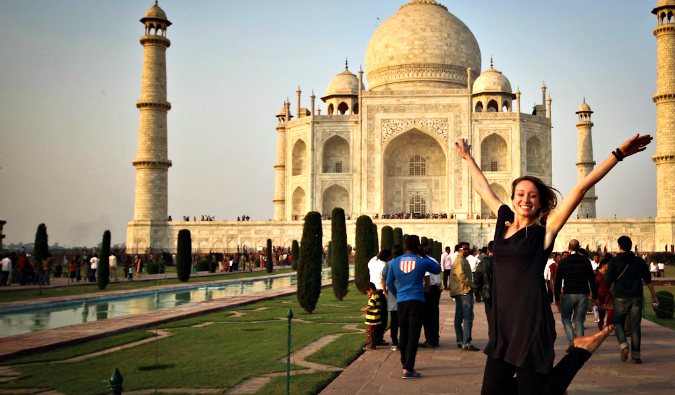
It happened to me at the Taj Mahal, in front of
the Gateway of India in Mumbai, and even on a beach in Puri, Orissa — I
was asked to have my photo taken with at least a dozen different
families or groups of young men. This may seem strange, but it’s usually
harmless.
11. Regroup – or even begin your time in India – away from big cities

Even if you follow the suggestions mentioned here so far and elsewhere on the web, harassment might still happen. If you have an experience that rattles your nerves, don’t leave India immediately. Take time out to process, heal, and regroup.
Think of heading to places such as
Dharamsala, home of the Dalai Lama and surrounded by the Himalaya;
Jaisalmer, an ancient fort city in the Thar Desert; Fort Cochin, a
colonial town with easy access to Kerala’s peaceful backwaters; and
lesser-known spots in Goa such as Colomb Bay, located between Palolem
and Patnem beaches.
These are all places where I found a certain
calm and respite from having to be on my guard so much, and I’d even
recommend starting your time in India in such locations. Although it’s
tempting to begin in the Golden Triangle — Delhi, Agra, and Jaipur — the
intense crowds there might not give you the space to adjust and adapt
to India.
Keep an open heart
Although India can be a difficult place to travel and there will be moments when being the center of attention is overwhelming, it is an experience I would redo again in a heartbeat. By using the tips above, I hope you can mitigate the feeling of having eyes inappropriately on you and transform uncomfortable situations into positive ones.
Although India can be a difficult place to travel and there will be moments when being the center of attention is overwhelming, it is an experience I would redo again in a heartbeat. By using the tips above, I hope you can mitigate the feeling of having eyes inappropriately on you and transform uncomfortable situations into positive ones.
Furthermore, keep in
mind that this issue of staying safe while visiting India is part of a
larger issue at hand: what it means to simply be a woman in India. The
threats facing female travelers are things that Indian women have been
dealing with their entire life, and will still be dealing with for long
after we leave.
Ultimately, there is no secret to staying safe in
India. It is a continual process of being wise and keenly listening to
your instincts — just as you would anywhere else in the world. Indians
love to welcome foreigners into their country, so trust your gut in
accepting their hospitality and learn from their kindness.


Post a Comment